skip to main |
skip to sidebar

On my previous trips past Büllsport I'd seen signboards for the Tsauchab River Campsite.
It was off my normal route but, on my way North a few weeks ago, I decided to detour and check it out ...
... I'm glad I did because, starting at the gate and all the way up the 300 meter driveway to the Reception Area, were hundreds of pieces of "Iron Art" created by the owner, Johan Steyn.
Above is a small display advertising one of the amenities of the Campsite, complete with Sunbather. Rusty Aardvark - Johan has a knack of capturing animal peculiarities which make his creations instantly recognizable.
Come linger awhile with me, under the Old Boot Tree ...
A determined Cyclist heads for the Hills.
One Blue Bottle - part of a display of dozens of similarly-colored Glass and Enamel items on an old dead tree.
What shade of blue would you say this is?
Bottle Blue?
A tufted Secretary Bird holds a Lizard in it's beak.
A Gas Bottle Couple lie basking in the Sunshine.
I wonder what the Bucket's for? ...
... junk dentures probably ...
I was informed by Johan that due to space restrictions he could only construct a half-Fokker - a proper one is two barrels long ...
... a local joke I guess ... :)
I enjoyed the private Bush Camp too, including a hot shower in the centre of a massive, ancient Wild Fig Tree.
... and surprises like this, a wooden Face in the Grass on one of the four-wheel drive tracks on the farm..
.JPG) In 2009 I posted this pic of a derelict building. I had snapped it from a moving car on the desert road between Aus and Lüderitz.
In 2009 I posted this pic of a derelict building. I had snapped it from a moving car on the desert road between Aus and Lüderitz.
It was one of hundreds of photos I had taken that day and I didn't know exactly where it was located on the road.
On my recent trip to the coast I was looking out for it because my Friend and fellow blogger, Aurora, had incorporated the building into one of her paintings: Monica named her work 'Hills of Namibia'.
I love the image - the house in the distance through the window - and, I was intrigued by the Crow and Red Onion on the window sill.
Because I'm not a 'food' person and I don't cook, I couldn't recall ever having seen a Red Onion - well, I've now discovered that they do exist and I've even seen and eaten some.
Anyway, I was determined to find this building again ... and I did:.jpg) To my great surprise it was at Garub - the place of the Wild Desert Horses featured in a recent post.
To my great surprise it was at Garub - the place of the Wild Desert Horses featured in a recent post..jpg) The derelict building stands next to the railway line running between Aus and Lüderitz.
The derelict building stands next to the railway line running between Aus and Lüderitz.
It's a short distance from the bore hole which now provides drinking water for the Desert Horses.
In the past, Garub was a watering point for Locomotives..JPG) No trains pass here now - the track near Lüderitz was covered by the shifting sand dunes and fell into disrepair.
No trains pass here now - the track near Lüderitz was covered by the shifting sand dunes and fell into disrepair.
Recently, work was started on the rehabilitation of the line but has come to a standstill - funding for the project has dried-up..JPG) In the early 1900s the building had obviously been Home to the person who maintained the water pump and replenished the Locos.
In the early 1900s the building had obviously been Home to the person who maintained the water pump and replenished the Locos.
He surely was an unusual character who voluntarily exiled himself to this desolation - there is no other habitation in sight..JPG) I was wondering about the people who had lived here so many years ago when, walking around the building, I found a strange Sign on one wall ...
I was wondering about the people who had lived here so many years ago when, walking around the building, I found a strange Sign on one wall ...
... 'They' had been here before me ... :).JPG) There is only one other similar derelict building on the 125km stretch of line, Grasplatz, a few kilos from Lüderitz.
There is only one other similar derelict building on the 125km stretch of line, Grasplatz, a few kilos from Lüderitz.
It was here that, in 1908, a railway worker found the first Diamond in Namibia. This triggered a diamond-rush and led to the establishment of Kolmanskop which is today, a famous Ghost Town.
Well, in my usual clumsy fashion I managed to mess-up the original 'Hills Of Namibia' post.
Thanks again to Monica for the painting. She is a talented artist - you can view more of her work at InnerLandscapes..
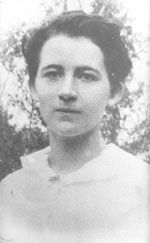 From About.com:
Helen Elizabeth Martins ('Miss Helen') is considered South Africa's foremost Outsider Artist.
(Outsider Art was first recognized by the French artist Jean Dubuffet, who coined the term 'Art Brut', or Raw Art, and described it as "fantastic, raw, visionary art created by individuals often maladjusted, with no art training, who work outside the mainstream of the art world.")
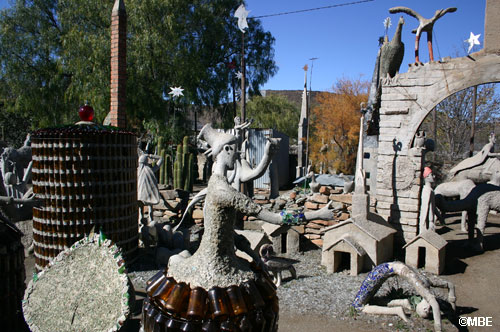 ... left with few prospects in a marginalized Karoo village, Martins became increasingly reclusive and isolated from the local community.
Known to the residents as 'Miss Helen' and thought of as a strange and rather outlandish character, she shied away from general contact, and began transforming her house and garden ...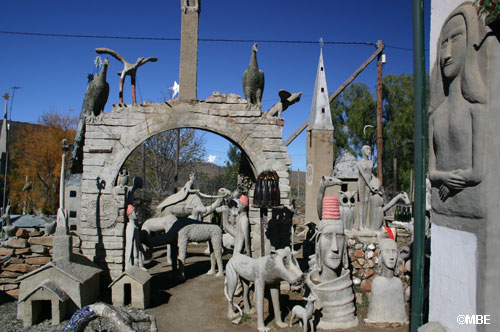 ... Helen Martins' art was greeted with derision and suspicion from the village.
Despite crippling arthritis, and the amputation of her small toes (her feet were disfigured from wearing narrow shoes) which left her unable to wear anything but slip-ons on her feet, Martins decorated her home with 'glass and light' ...
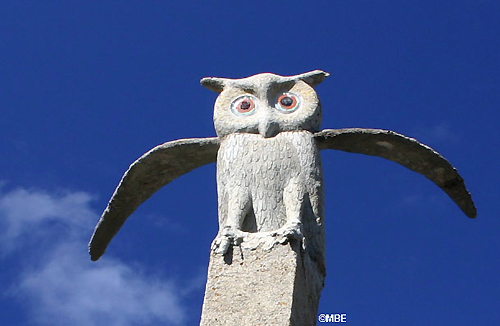 ... In 1964 Helen Martins employed Koos Malgas, an itinerant sheepshearer, to help her make the cement-and -glass statues which fill the Camel Yard outside her house. Formally the garden, this sculpture yard had over 300 figures and animals.
Malgas became her foremost friend and companion, and remained by her side for the last 12 years of her life. Helen's close relationship with her Coloured assistant was viewed with great suspicion by Nieu Bethesda's Apartheid era residents ...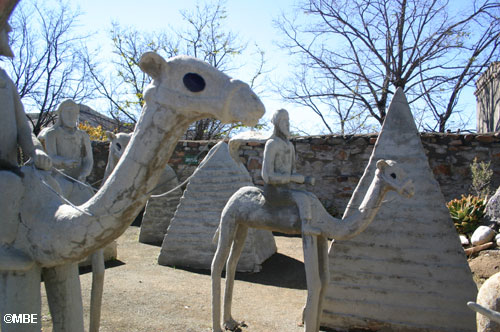 ... Helen Martins' eyesight began to fail and in 1976 she took her own life by swallowing a mixture of caustic soda and crushed glass in olive oil.
She could not bear the thought of going blind - a great theme in her life and work is light - and she was worried that she would be taken away from her life's work.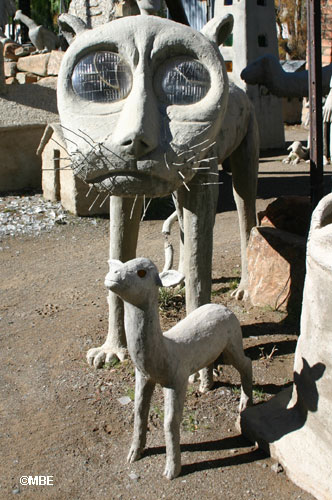 Koos Malgas remained for another two years before relocating to Worcester, but returned in 1991 to assist in the restoration of the Owl House which had been declared a national monument and was supported by the newly created Owl House Foundation.
It had been Helen Martins' greatest wish that the Owl House and Camel Yard be preserved as a museum.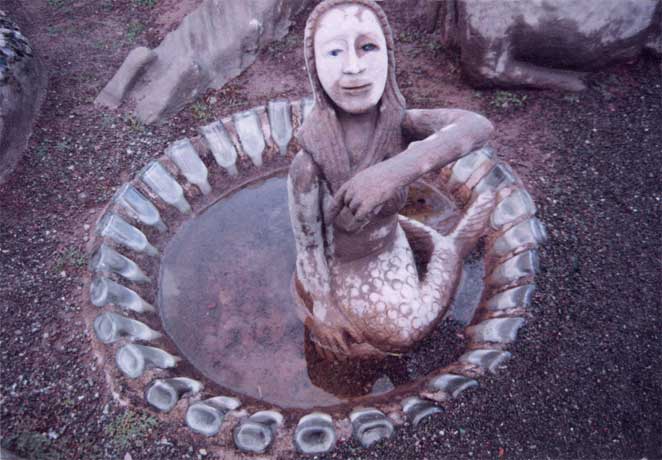 I would love to make a pilgrimage to Miss Helen's Owl House someday - I feel like we share a similar twist of mind ...
More info and images here and here.
Images in this post by Marion Boddy-Evans
.

Jared Njuguna
GourdFrom the homepage of True African Art: 'True African Art.com is an African art paintings online gallery store. Our concentration is on contemporary African paintings by African artists.'
Michael Wafula
Prayers Under God's Eye'In our online African art paintings gallery, on many of our pages, you can watch exclusive video interviews of our African painter artists made on the scene in Kenya, East Africa.
These videos not only show you that we know our artists personally, but they also let you get up close to the people and culture that make the Black African art paintings you love.
The website also has extensive, unique, first hand biographical information on most of its African artists.'
Songoho
Island SunriseThe owner of True Africa Art, Gathinja Yamokoski, was born in Kenya and, being an artist herself, also features a page showcasing her own work on the site.

Gathinja Yamokoski
UlulationPay True African Art a visit if you're interested in African Art - you'll probably find something you like ....

Le Chat Botté - Puss In Boots

Le Singe et le Dauphin - The Monkey and the Dolphin

Sleeping Beauty

Little Red Riding Hood
Gustave DoréGustave Doré (January 6, 1832 – January 23, 1883) was a French artist, engraver, illustrator and sculptor. Doré worked primarily with wood engraving and steel engraving.
Doré was born in Strasbourg and his first illustrated story was published at the age of fifteen. At age five he was a prodigy artist already creating drawings. When he turned 12 he began to carve his art in stone.
Doré began work as a literary illustrator in Paris. Doré commissions include works by Rabelais, Balzac, Milton and Dante.
In 1853 Doré was asked to illustrate the works of Lord Byron. This commission was followed by additional work for British publishers, including a new illustrated English Bible.
In 1863, Doré illustrated a French edition of Cervantes's Don Quixote, and his illustrations of the knight and his squire Sancho Panza have become so famous that they have influenced subsequent readers, artists, and stage and film directors' ideas of the physical "look" of the two characters.Many more examples of his work here..


.jpg)
.jpg)
.jpg)
.jpg)

