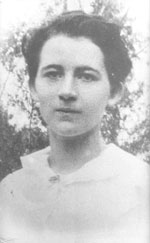
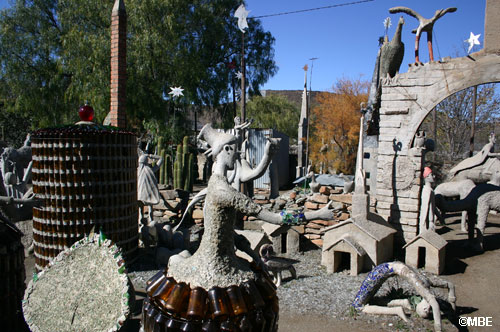
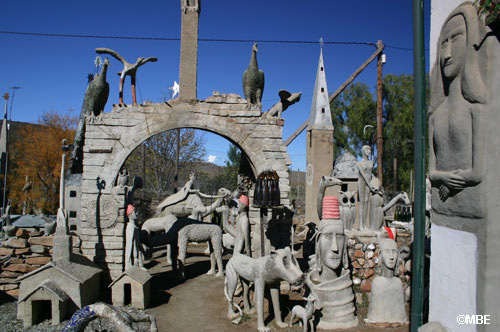
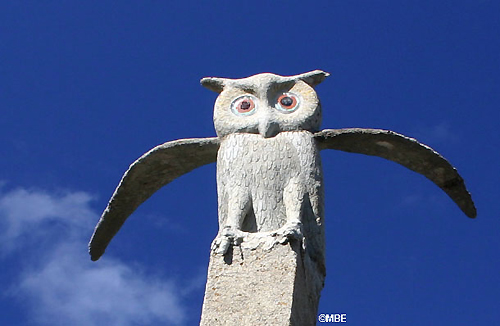
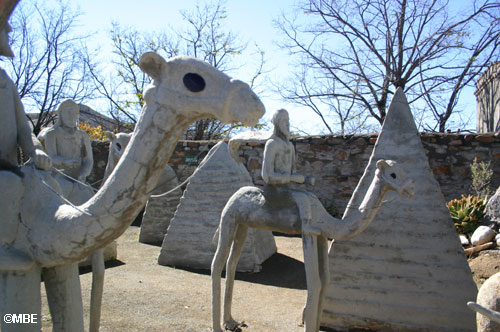
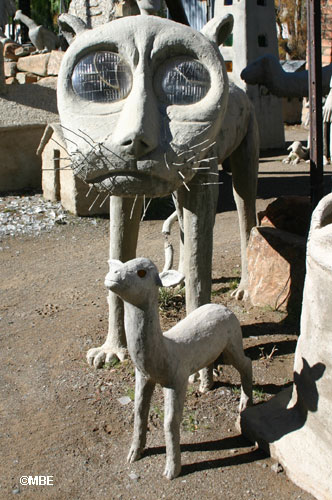
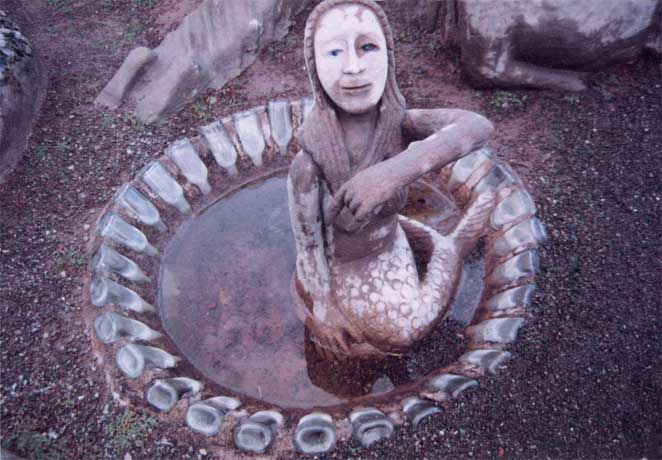
Helen Elizabeth Martins ('Miss Helen') is considered South Africa's foremost Outsider Artist.
(Outsider Art was first recognized by the French artist Jean Dubuffet, who coined the term 'Art Brut', or Raw Art, and described it as "fantastic, raw, visionary art created by individuals often maladjusted, with no art training, who work outside the mainstream of the art world.")
... left with few prospects in a marginalized Karoo village, Martins became increasingly reclusive and isolated from the local community.
Known to the residents as 'Miss Helen' and thought of as a strange and rather outlandish character, she shied away from general contact, and began transforming her house and garden ...
... Helen Martins' art was greeted with derision and suspicion from the village.
Despite crippling arthritis, and the amputation of her small toes (her feet were disfigured from wearing narrow shoes) which left her unable to wear anything but slip-ons on her feet, Martins decorated her home with 'glass and light' ...
... In 1964 Helen Martins employed Koos Malgas, an itinerant sheepshearer, to help her make the cement-and -glass statues which fill the Camel Yard outside her house. Formally the garden, this sculpture yard had over 300 figures and animals.
Malgas became her foremost friend and companion, and remained by her side for the last 12 years of her life. Helen's close relationship with her Coloured assistant was viewed with great suspicion by Nieu Bethesda's Apartheid era residents ...
... Helen Martins' eyesight began to fail and in 1976 she took her own life by swallowing a mixture of caustic soda and crushed glass in olive oil.
She could not bear the thought of going blind - a great theme in her life and work is light - and she was worried that she would be taken away from her life's work.
Koos Malgas remained for another two years before relocating to Worcester, but returned in 1991 to assist in the restoration of the Owl House which had been declared a national monument and was supported by the newly created Owl House Foundation.
It had been Helen Martins' greatest wish that the Owl House and Camel Yard be preserved as a museum.
I would love to make a pilgrimage to Miss Helen's Owl House someday - I feel like we share a similar twist of mind ...
In all the years I've visited the Etosha Pans I've never been able to get up-the-nostrils close to any of the big Cats - this last visit was no different but, I did encounter Lion at a distance on two occasions:
The first time we came upon a pride eating their previous-night's kill, they were about 150 meters from the road and it was difficult to get any good shots.
They were finishing-off the remains of some hapless beast. It was impossible to see what kind of animal their prey was but someone told me that it was a Zebra.
There were about 30 to 40 Jackals gathered on the outskirts of the feast, hoping for some scraps. Here one of the male Lions chases some of them off after they ventured too close.
The next day we spotted this male sleeping under a bush about 50 meters from the road - I got the mental impression of a fat golden sausage lying in the shade.
He was obviously feeling satiated from the previous day's kill and we had to wait about half-an-hour before he even blinked an eyelid.
He probably wanted to get rid of us curious humans so he posed for a few shots - nice gnashers hey?
Finally, he became bored and with a great big yawn he lay down and went to sleep again.
A LION TALE
I'll probably be in trouble for telling this story but, it involves lions so here goes:
A few years ago my daughters and I were in Etosha when we spotted two lions lying under a tree about 50 meters off the road, like the fellow in the pics above.
We stopped to observe them and within minutes were surrounded by about five carloads of tourists all jockeying for a good viewing position.
Everyone had their windows open, hoping that the lazy animals snoozing in the shade would do something so that they could take photos.
It was steaming hot and uncomfortable but, this was the vibe, the ambiance of Africa - stifling heat, dust, sweat and, best of all, lions in their natural environment. Everyone was entranced, quiet, the air thick with expectation.
We were in a double-cab pickup, my daughters in front and me on the backseat. It was obvious to me that the lions weren't going to provide any show. I was becoming bored so I dreamily reclined on the seat, bare feet sticking out the window.
After awhile, in a near-stupor, I felt the need to break-wind. Unfortunately, what I thought would be a little 'sneaker' turned out to be a thunderclap which destroyed the pristine silence.
Well, except for a muted snigger from one of the cars, there was once again complete silence after my lion impersonation but, the damage had been done, the ambiance shattered.
The girls turned around and glared at me as they tried to become invisible in their seats.
Nadine started the car and we slunk away. Being the coward that I am, I continued lying out of sight on the back seat and let them take the heat of embarrassment.
Needless to say, I was in the dog-box for the rest of the day.
So, on the off-chance that a visitor who was there that day reads this, I'd like to apologize for ruining your African Experience.
I've lived within 60km of the Hoba Meteorite for more than 30 years but, until recently, had never visited it.
The Meteorite was declared a National Monument in 1955 and, in 1987, the owner of the farm on which it lies donated the ground and meteorite to the Namibian Government. The uranium mining company Rössing assisted with funding to develop the area to create a community income-generating project.
Thousands of tourists visit the site each year and a humorous sign at the entrance warns of the danger of falling meteorites. Could this have been the sky that fell on Chicken Licken's head?
The area around the meteorite has been spruced-up and camping sites developed.
The Hoba meteorite left no preserved crater and its discovery was a chance event. In 1920, the owner of the land is said to have encountered the object while ploughing one of his fields with an ox.
One of the signs providing information about the meteorite - it is the largest known meteorite (as a single piece) and the most massive naturally-occurring piece of iron known at the Earth's surface.
A close up of the meteorite showing how, over the years, people have tried to hack-off pieces as souvenirs - this type of vandalism has now been stopped by having a permanent caretaker on site.
Well I'm ducking-out and I'll be laying low for a few days ... ciao.
Kwela is a happy, often pennywhistle-based, street music from southern Africa with jazzy underpinnings and a distinctive, skiffle-like beat. It evolved from the marabi sound and brought South African music to international prominence in the 1950s.
The music has its roots in southern Africa but later adaptations of this and many other African folk idioms have permeated Western music (listen to Graceland by Paul Simon) and give modern South African music, particularly jazz, much of its distinctive sound and lilting swagger.
One reason for the use of the pennywhistle is that it is cheap and portable, but it also lends itself as a solo or an ensemble instrument.
The popularity of the pennywhistle may have been based on the fact that flutes of different kinds have long been traditional instruments among the peoples of the more northerly parts of South Africa, and the pennywhistle thus enabled the swift adaptation of folk tunes into the new marabi-influenced music.
Image Credit: Unknown
I remember, as a kid in the early 60's, being entranced by Kwela buskers playing on the streets of mid-town Johannesburg - the groups usually consisted of three people; a pennywhistler, an acoustic guitarist and a bassist playing a bass constructed from an old upturned tea-box which had only one string ...
Here's an example of the Kwela and the pennywhistle by Spokes Mashiyane:
Signs warning of the presence of Warthog are common along the highway in northern Namibia.
They graze along the highway verges and often cross the road in front of oncoming vehicles - hitting one of them can severely damage a small car or cause death if the driver swerves and loses control.
On my recent visits to Etosha I saw a few groups, (or 'sounders' as they're officialy known), feeding close to waterholes, like the sow and her two babes above.
Warthogs often get down on their front knees to feed on roots and tubers and over time develop callouses. They feed mainly during the day and at night sleep in abandoned antbear holes which they've adjusted to suit their own requirements.
Sounders usually consist of an adult male and female and her offspring of one or two consecutive litters - despite their appearance they seem quite affectionate towards each other and fiercely protect their young.
The warthog's name is derived from the protuberances on their faces, more prominent in the males, as can be seen from the pic above - two below the small beady eyes and two above the snout.
Warthog meat is eaten by humans - I tried it once but didn't like it.
Warthogs love to wallow in mud as can be seen from the white coloring of the animal above, (look at the size of this one's tusks too), - a mud coating assists in protection against biting flies and also plays a role in thermo-regulation.
Despite their ugly appearance warthogs are endearing creatures and even have a trucking company named after them - another warthog on the road to look out for ...
References: Amy Schoeman - Notes On Nature RHN Smithers - Land Mammals Of South Africa
John Filo's iconic Pulitzer Prize-winning photograph of Mary Ann Vecchio, a fourteen-year-old runaway, kneeling over the body of Jeffrey Miller after he was shot dead by the Ohio National Guard.
Today is the 40th anniversary of the shootings at Kent State University. These deaths — William Schroeder, Sandra Scheuer, Jeffrey Miller and Allison Krause — at the hands of the Ohio National Guard on May 4, 1970, persist as a significant historical marker.
The incident is today seen as the moment the free-spirited idealism of the Sixties collided head-on with the state’s deadly coercive powers. A nation’s youth, attempting to exercise their rights to free speech and assembly, were deliberately gunned down by their own government.
That the deaths were immortalized in iconic photos and the song Ohio by the band Crosby, Stills, Nash and Young, which still receives substantial airplay today, has solidified the incident’s stature as a signature moment in modern social and cultural history.
But here’s another way of looking at it. Kent State was one of the biggest blunders ever committed by the American military.
This incident had a profound effect on me at the time and throughout the forty years since it happened. The images have often popped into my mind, especially when I listen to Cosby, Stills, Nash and Young's song 'Ohio':
Tin soldiers and Nixon coming, We're finally on our own. This summer I hear the drumming, Four dead in Ohio.
Gotta get down to it Soldiers are cutting us down Should have been done long ago. What if you knew her And found her dead on the ground How can you run when you know?
On my recent one-day trip to Namibia's Etosha National Park I saw no elephants, which was not surprising because during the rainy season they tend to migrate away from the established waterholes to areas where the vegetation is less under pressure.
On my second visit though, I felt more hopeful of spotting some when we came upon fresh dung lying on the road:
A few minutes later we encountered this lone bull who proceeded to a wash himself in a mud pool:
An elephant's trunk is extremely versatile, it's used for plucking food and sucking up water which is transferred to the mouth or sprayed over the body for cooling.
He obligingly sat down in the mud and posed for a few seconds:
Migratory herds probably inhabited this area for thousands of years but by 1881, after the arrival of Europeans and modern firearms, there were no elephant left in Etosha.
In 1954 small numbers started making their way back into the park.
During the 70s, due to the creation of additional water points in the park to attract them and the pressure of expanding human settlements outside the park, elephants started migrating back into Etosha.
Today, there are so many that the occasional controlled culling is necessary, elephants being second only to man in their ability to destroy and alter the environment.
A few minutes after leaving our bathing beauty above, we came upon a herd of about 40 animals:
They were mainly females and their offspring - it's beautiful to watch how the smallest babes are protected and herded by the adults.
Etosha's elephants are the largest in Africa but their tusks are also the smallest.
They crossed the road a short distance ahead of us:
The driver of the car closest to where they were crossing had his vehicle in reverse gear, ready to make a quick getaway.
I don't blame him for being nervous because these jumbos can look really menacing when they're close and stare at you with flapping ears, like this group who stopped to look at his car, though in this case they were being curious rather than aggressive:
I've never heard of an elephant attacking a car - I'm not saying it hasn't happened - but, in my experience it's best to just sit quietly, starting or revving a car's engine just seems to make them more agitated, especially when there are young babes in the herd.
After this large group, we saw only two solitary males for the rest of our three-day stay in the Pans, this nice clean fellow below:
... and a bull who passed so close I was able to get a shot of his long eyelashes:
Well, after the first sightings, my visit to the pans was partially satisfying - I had seen the magnificent elephant, but no big cats, ... yet.
References: Amy Schoeman - Notes On Nature RHN Smithers - Land Mammals Of South Africa
The provision of basic necessities like clean drinking water and fuel for cooking are time-consuming daily chores for many in Africa.
Often people must travel long distances to fetch water from communal water points or gather wood in the bush, or in dry river beds in arid areas where the only trees grow.
Look at the women carrying water - I would probably collapse after about ten meters with one of those containers on my head.
Running water in my house is something I take for granted and I've felt afraid and insecure when I've had problems with the bore hole on the smallholding and been without water for a few days.
I was going to do a post today on elephants but changed my mind after reading this post by Canadian blogger Joyful
My apologies for the poor picture quality, some of them were snapped from a moving car.