skip to main |
skip to sidebar
After leaving Warmbad the day's destination was Karasburg, 48 km to the North.
Instead of going directly there though, we headed South first, 78 km to the Orange River and Vellorsdrif, a remote border crossing to South Africa - just to see what there was to see. I'd seen 'Tantalite Valley' marked on a map and was intrigued, so we took this road which ended 20 km later at a deserted Mine. The buildings were still in reasonable shape and it looked like mining may resume in the future.
At the time I had no idea what Tantalite is - I thought it had something to do with Mica because there was a lot of it around but it's turns out that it is a source of Tantalum.
Tantalum is a chemical element, used in alloys for strength and higher melting points, in glass to increase the index of refraction, and in surgical steel, as it is non-reactive and non-irritating to body tissues. The countryside around Warmbad had been pretty drab and featureless but this changed approaching the Orange River, to scattered Quiver Trees and hills, the sides of which were patterned with roundish black rocks.
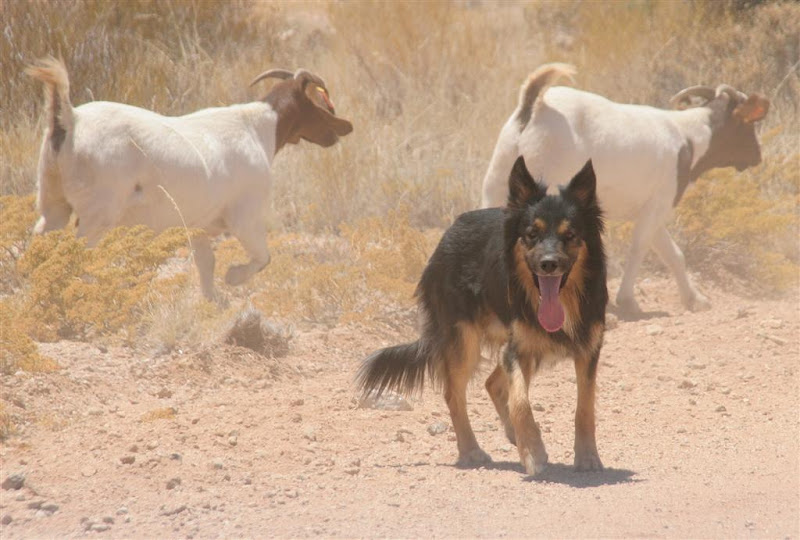 A furry Goatherd turns to check me out.
 Sociable Weavers' nests in a quiver tree.
 This rock tower suddenly appeared on the skyline on the road between Ariamsvlei and Karasburg - it's probably about 15m high - it's what I'd originally envisioned for the en suite bathroom I'm building on my house.
I'm impressed with the straightness of the walls, quite a tricky task.
In Karasburg I heard that the farmer had constructed it in order to deter poachers. Late afternoon we reached Karasburg - a drab town set in a desolate landscape. I have no idea what caused it to come into existence, the only industry in the area is a few large farms.
Although Karasburg is in better shape than Warmbad the majority of the population also lives in abject poverty.
Many people were obviously intoxicated and openly consuming alcohol. To me, the overall impression was depressing. Two women and children walk along the road carrying their possessions.
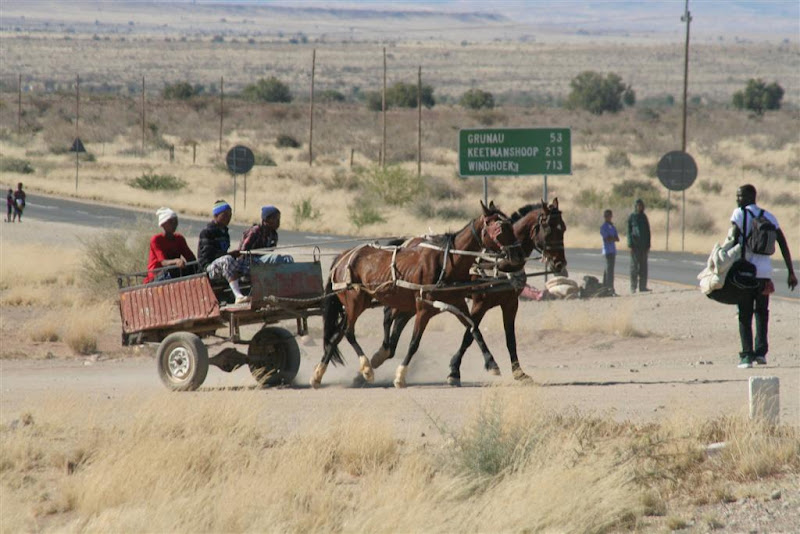 Horse and Donkey transport is common in Namibia and generally the animals are in reasonable shape but I was disturbed by the poor condition of the many horses I saw in Karasburg.
 These girls, aged between about 12 and 14, were hanging around in front of a general store and when they saw me sitting in the car with a camera they asked me to take their pic - taking great delight in viewing the images in the LCD screen.
I saw that the young lady in the left of the pic was talking to me and indicated to her that I couldn't hear what she was saying - with all the familiarity in the world, she grabbed my head with both her hands, pulled it out of the window and shouted in my ear that I should give her some money.
I asked her what she wanted money for and she replied that she wanted to buy bread. I hesitated a moment because I've given kids money before, only to see them spend it on sweets.
I gave her some money and watched them rush into the shop - they emerged with a loaf of bread.
Looking at close-ups of their faces makes me feel sad because I know that, barring a miracle, these kids will be trapped in a cycle of poverty for the rest of their lives - and there are millions more like them throughout the world, living without hope. This smartly-dressed lady posed for a picture - she was with a friend and both were dressed in identical outfits - one of the girls from the previous pic photo-bombing the scene ... :).
Every year, the period leading up to Christmas through to the new year is usually a time of introspection for me - I don't know if it's a programmed response or what.
This year, Comfortably Numb by Pink Floyd is my song to reflect on:
When I was a child I had a fever
My hands felt just like two balloons.
Now I've got that feeling once again
I can't explain you would not understand
This is not how I am.
I have become comfortably numb.I am not a Christian but I've spent my whole life in a Christian culture and cannot help but be caught up in the Season.
To my Christian friends, I wish You a Blessed Christmas with your Loved Ones and offer you this Carol, Gaudete (Rejoice), composed in the 16th century and performed here by one of my favourite Folk Groups, Steeleye Span:Gaudete, gaudete Christos est natus
Ex Maria virginae, gaudete.
Tempus ad est gratiae hoc quod optabamus,
Carmina laetitiae devote redamus.
Gaudete, gaudete Christos est natus
Ex Maria virginae, gaudete.
Deus homo factus est naturam erante,
Mundus renovatus est a Christo regnante.
Gaudete, gaudete Christos est natus
Ex Maria virginae, gaudete.
Ezecheelis porta clausa per transitor
Unde lux est orta sallus invenitor.
Gaudete, gaudete Christos est natus
Ex Maria virginae, gaudete.
Ergo nostra contio psallat jam in lustro,
Benedicat domino sallas regi nostro.
Gaudete, gaudete Christos est natus
Ex Maria virginae, gaudete.Gaudete, gaudete! Christus est natus Ex Maria virgine, gaudete!
Rejoice, rejoice! Christ is born Of the Virgin Mary, rejoice!.


