skip to main |
skip to sidebar
My buddy, Stretch Moonman, gave me some images of pythons which hatched in the Reptile Park where he's the curator:
 One of the Pythons in Stretch's care.
The Southern African Python is the largest snake in Southern Africa, averaging 3-4 m long. Previously known as the African Rock Python, it's called 'Ombome' by the Owambo people of Namibia.
Pythons are extremely valuable in controlling rodent populations but are indiscriminately killed by fearful, ignorant humans.
Pythons have been reported to kill people but this is very rare. Pythons can however, inflict painful and dangerous bite-wounds which may require medical attention.
I once kept a small python, Monty, for a while but released 'him' into the bush after he slithered into my shirt and left a row of bloody teeth marks on my back.

A clutch of eggs laid by one of the large females in the Reptile Park early this year.
Pythons usually lay between 30-60 eggs and are the only snake I know of which incubate their eggs and remain with the babies for two weeks or more after hatching.
The eggs, each slightly smaller than a tennis ball, hatched after 91 days.
 Mama raises her head in a defensive posture, her body coiled around the 21 newly-hatched babes.
 Awwwww ...
 I visited Stretch earlier this year and photographed two of the babes which he had in his living quarters.
Stretch doesn't have to worry about break-ins and thefts - no would-be thief has the courage to enter his house because of his reputation for keeping all kinds of dangerous snakes.
 One of the two babes in Stretch's house was the 'runt' of the litter (with the spot, or scar on it's forehead).
When I last spoke to him, he said that the poor creature had all sorts of health problems and that he thought it will not survive.
 Stretch displays some of his 'babies' before taking them out into the bush and releasing them.
The harsh reality is that very few of them will survive to adulthood, most will be eaten by birds of prey and other predators.
 I wonder what the collective noun is for a bunch of baby pythons ... a Medusa?
References:
Johan Marais - Snakes Of Southern Africa.
.
A few pics of snakes I've encountered recently: Stretch Moonman catches a Western Stripe-bellied Sand Snake at the Namutoni Camp in Etosha - quite a feat as this is probably the fastest snake in southern Africa. It's mildly venomous but not dangerous to man.
I was taking pics when he released the creature - it came speeding between my legs before I could focus a shot.
This incident occurred about a hour before our Elephant Adventure.
 Back at the Snake park where Stretch is the curator, he took me into the cage containing a Western-barred Spitting Cobra which he coaxed into spreading it's hood and spitting.
Naja nigricollis also injects a potent venom for which there is no anti-venom. Nadine, a Brown House Snake - Lamprophis capensis - named after one of my two daughters who worked at the Lodge for awhile.
Harmless to humans, the House Snake feeds mainly on rodents, birds and lizards, which it kills by constriction. A Puff Adder - Bitis arietans - this is the only snake I loathe with a passion, mainly because, unlike other snakes who usually move off when they detect the approach of humans, the Puffy is lazy and just stays lying where it is, often well camouflaged in long grass or under dead leaves - a trap waiting to be stepped on.
It strikes easily and has a potent tissue-destroying venom which can cause terrible disfiguring injuries or death if untreated. Stretch took a hit from a Puff Adder about four years ago and I took these pics about three days after the incident. I must admit I expected the worst, I thought that he was going to lose his thumb. These are the 'nice' pics - they get worse as the venom spread.
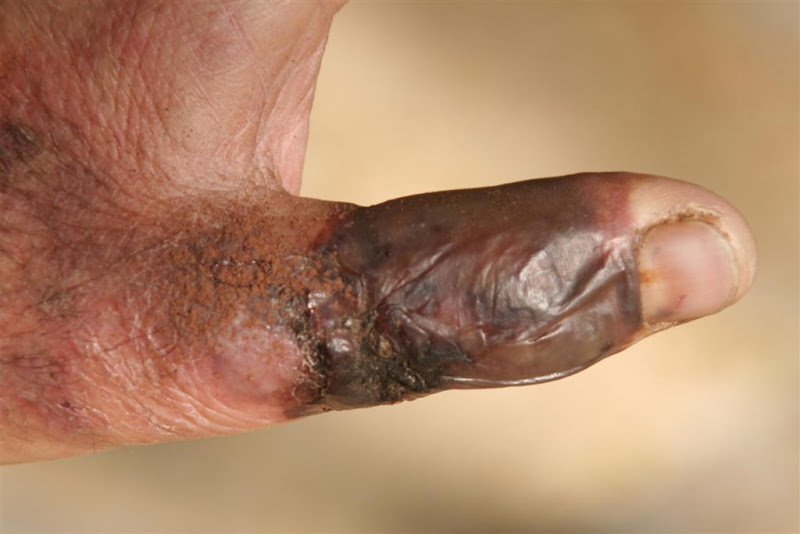 Having witnessed the excruciating pain he went through I have great respect for Stretch - I believe it was only his attitude and mental strength which saved him from losing his thumb and, indeed, his whole hand.
I fear that under similar circumstances I might have cracked. A Cape Cobra, (not sure of ID), eating eggs after chasing one of my hens off her nest - the bird was lucky because often the Cobra strikes at night, killing the hen when she refuses to move off the nest in the dark.
The snake was lucky too - a few years ago I would have reached for my shotgun, not my camera.
I was alerted to it when the birds started making an unholy racket outside. See the egg in it's throat? - he got away with two.
Spirit was frolicking around my feet as I was taking pics, unaware of the danger.
Afraid that he'd accidentally pounce on the snake I grabbed him and chucked him into the house - when I returned the snake had disappeared into a thick Privet hedge.
What with snakes, mongooses and bush-cats, it's amazing that I have any chickens left at all.Related Posts:
Cape Coral Snake - Aspidelaps lubricus lubricus
Horned Adder - Bitis caudalis
.
 Earlier this year I visited our local Crocodile Ranch - it's in an unusual location because Otjiwarongo is far from their natural habitat in northern Namibia where they're found in the Kunene, Okavango, Zambezi, Liambezi and Kwando Rivers as well as in the Okavango Swamps.
 Our local species is the Nile Crocodile, Crocodylus niloticus, which is, (or was), widespread throughout central and southern Africa. The bigger ones in these pics are for breeding purposes.
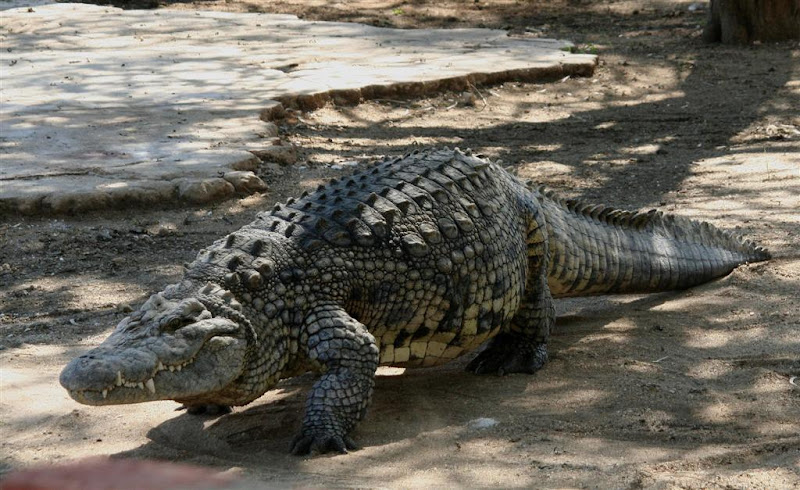 A very large specimen going walkies - they don't seem to walk very far before flopping down on their bellies to rest.
Personally, these reptiles give me the creeps, I think it's their cold eyes that turn me off. At least with a Lion, it seems that they may be open to discussion before they eat you - not so with a croc. One of the nurseries. If I remember correctly our guide, Tate Ganache, said that these were about two years old.
They're bred mainly for their skins which are made into belts, handbags and shoes. I checked-out some of the items on sale and was astounded at the prices they were asking, way beyond what the average person could afford (if you're inclined to adorn yourself with crocodile skin).
Apparently, some of the meat is eaten in exotic restaurants but ewwwww ... not for me thanks!
 There are hundreds of young crocs in the temperature-controlled nurseries. It's pretty humid and smelly in there.
I couldn't resist asking Tate Ganache how they were slaughtered when they are ready to be harvested and he replied that they're dispatched with a .22 bullet in the skull.
 Smile for the camera.
A croc's teeth are not used for chewing, they serve as clamps to hold their prey while they drag it under the water. If a tooth is lost, it is soon replaced by a new one. They account for many human deaths in Africa each year.
 Crocodile Toilets - everyone knows it's not cool to pee in the pool ...
Crocodiles have an immensely long evolutionary history, 'relics' from the Mesozoic Era between 140 to 240 million years ago, they have seen continents shift and have persisted through many ice ages - can they survive the age of Man?References:
Amy Schoeman - Notes On Nature
.

 From the Source: Albertus Seba (1665-1736) was a Dutch apothecary and collector, who, in the 1730s began a project to publish a fully-illustrated catalogue of his renowned collection of naturalia. Seba oversaw the production of the first two volumes of this opus, Locupletissimi Rerum Naturalium Thesauri Accurata Descriptio..., issued in 1734 and 1735. Two further volumes were issued posthumously, in 1758 and 1765.More images at the source.

 OneStonedCrow Pics
HORNED ADDER
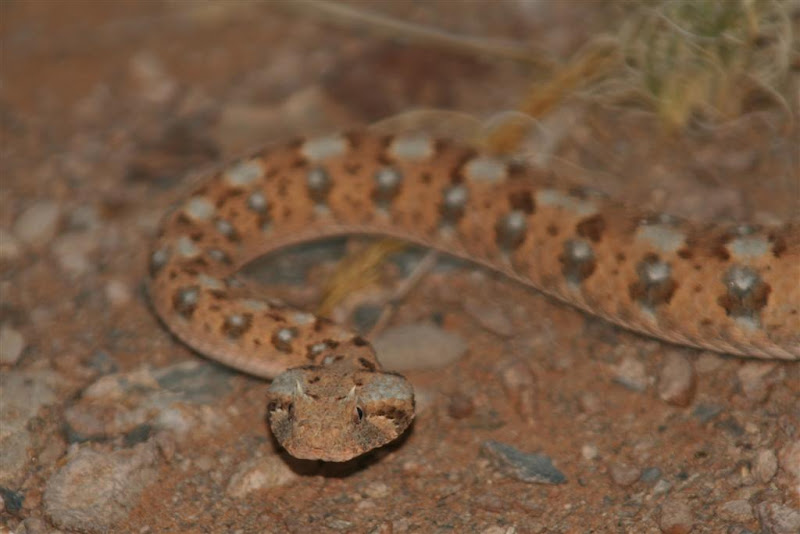
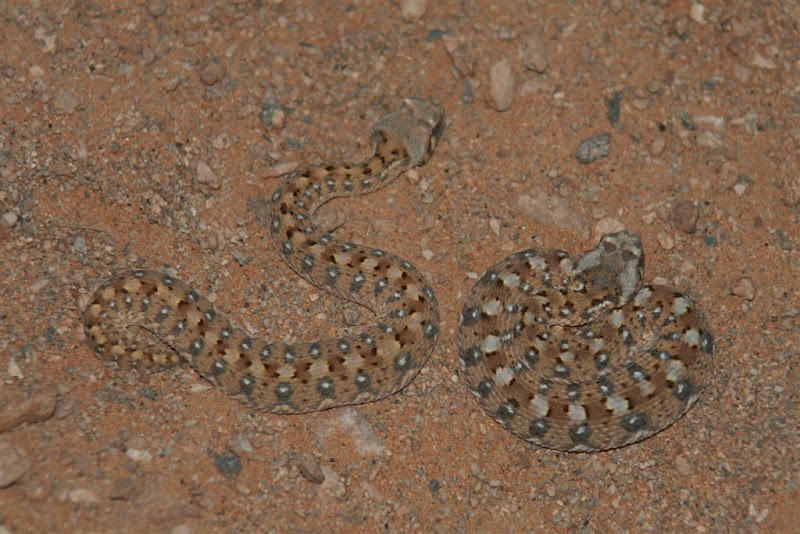
Bitis caudalisI often encounter these well-camouflaged snakes when walking in the desert at dusk, the time that they're most active. Adults average between 25 and 40cm long; they eat small lizards, rodents, birds and frogs. The Horned Adder's name is self-descriptive.
Their venom is mildly cytotoxic,(tissue destroying), causing swelling and much pain, accompanied by shock and local necrosis but has not been known to be fatal.
With reference to the two lower pics, a friend returned from a walk in the desert and told me she'd seen a snake. When I went to investigate, I found that it had just given birth. I counted five babies who were just escaping from their egg-like sacs. Mama was not very happy to have me around,(center pic), so I snapped a few photos and retreated in case I stepped on one - as you can see, they blend in very well with the sand.
.

OneStonedcrow PicWestern Cape - South Africa
.
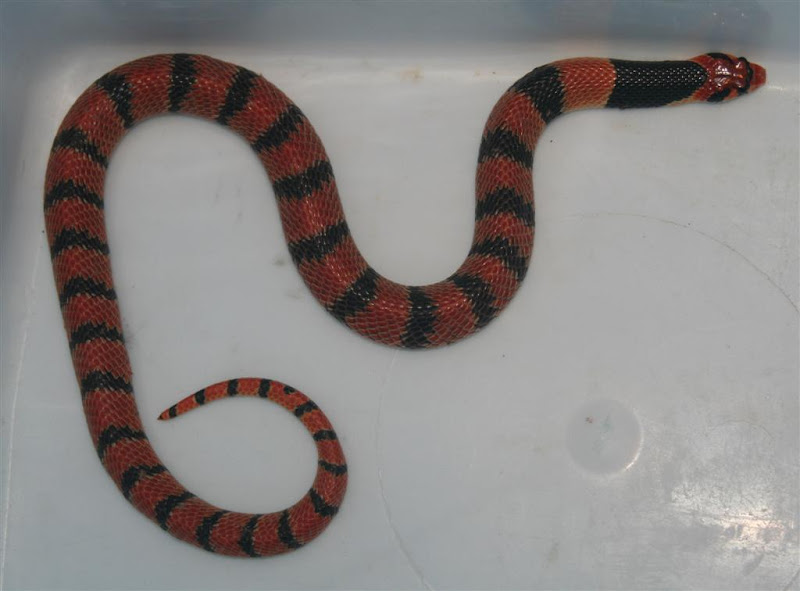
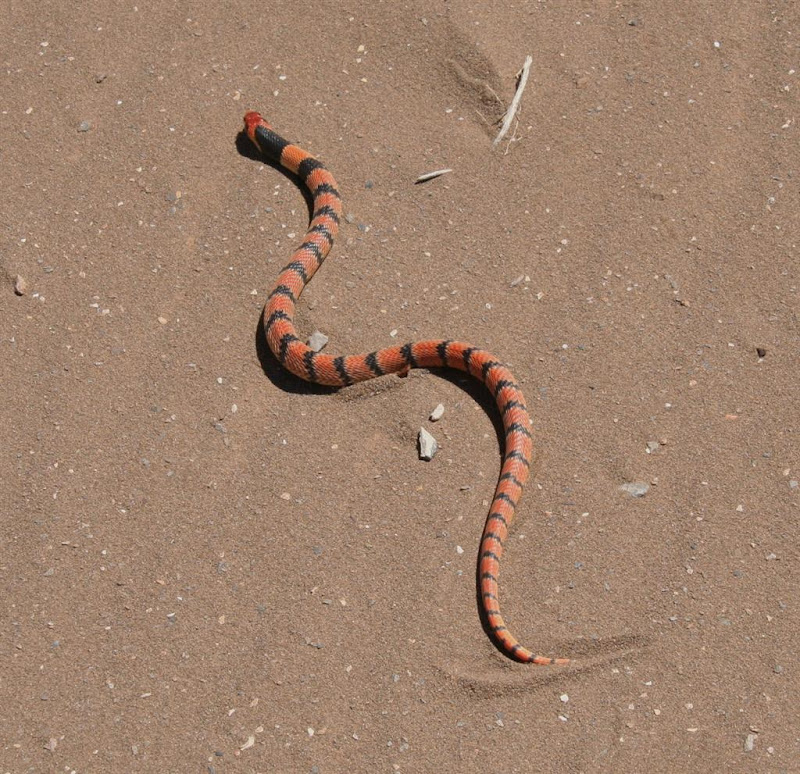 OneStonedCrow PicsCAPE CORAL SNAKEAspidelaps lubricus lubricusThis colorful specimen, about 40cm long, was captured on a neighbor's veranda one evening and contained in a cooler box overnight.
The next day I went into the desert to release it, hoping to take some cool pics in it's natural environment. Hah! ... as soon as I tipped the box over it attacked me; most of the shots turned out fuzzy because I was too busy dodging and running. Eventually it maneuvered itself close to a small scrub bush and disappeared.
It is well known for being a very bad-tempered snake, even after years in captivity.
The Coral snake eats lizards, other small snakes and rodents.
Virtually nothing is known about the venom of this snake, though it is believed to be dangerously neurotoxic (nerve destroying).
.


