skip to main |
skip to sidebar
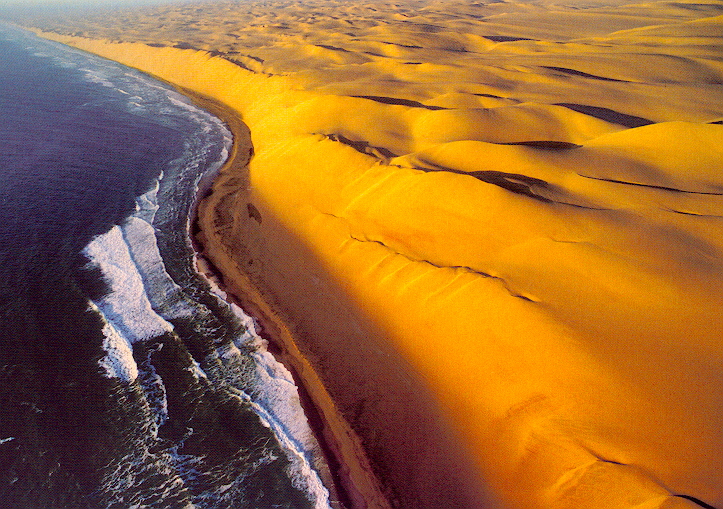
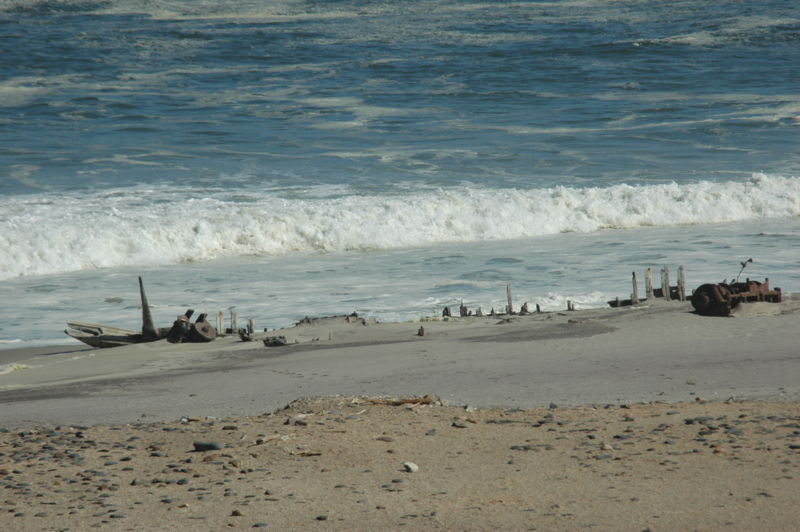
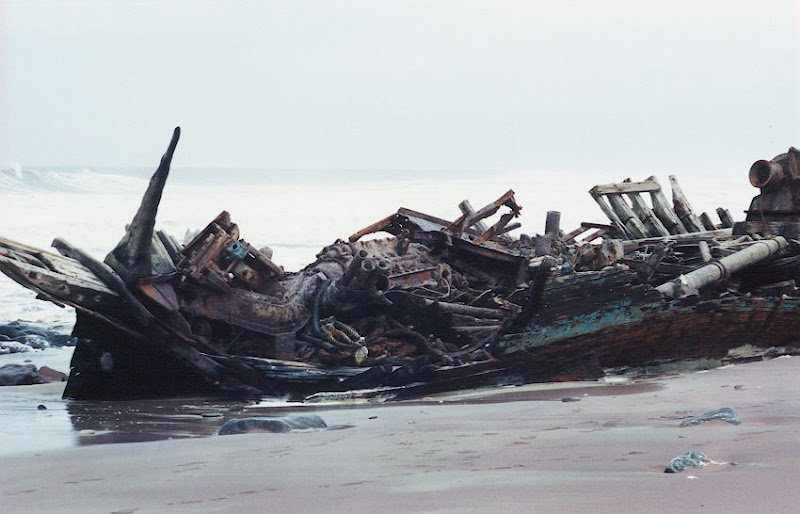
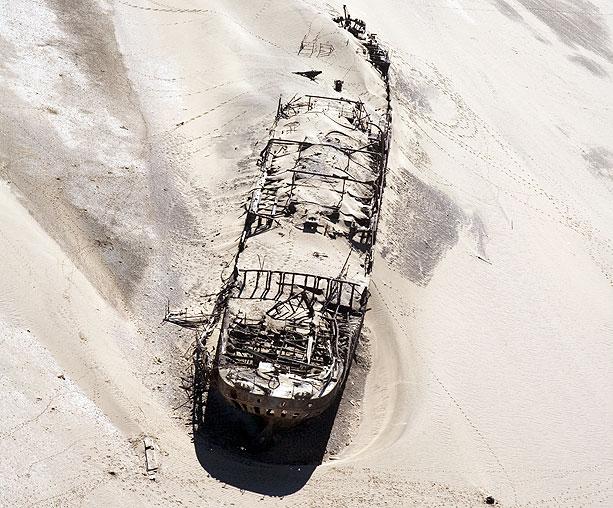
Photo Credits: UnknownThe Skeleton Coast (German: Skelettküste) is the northern part of the Atlantic Ocean coast of Namibia and south of Angola from the Kunene River south to the Swakop River, although it is sometimes used to describe the entire Namib Desert coast.
The San people of the Namibian interior called it the region "The Land God Made in Anger", while Portuguese sailors once referred to it as "The Gates of Hell".
On the coast the upwelling of the cold Benguela current gives rise to dense ocean fogs (called "cassimbo" by the Angolans) for much of the year. The winds blow from land to sea, rainfall rarely exceeds 10mm annually (.39 inches) and the climate is inhospitable.
There is a constant, heavy surf on the beaches. In the days of human-powered boats it was possible to get ashore through the surf but impossible to launch from the shore. The coast is named for the bleached whale and seal bones which covered the shore when the whaling industry was still active, as well as the skeletal shipwrecks caused by rocks offshore in the fog.
More than a thousand vessels of various sizes and areas litter the coast. Notable wrecks in the region include the Eduard Bohlen, the Otavi, the Dunedin Star, and Tong Taw.
Evidence of some human occupation, in the form of the Strandloper people in the past, is evidenced by shell middens of white mussels found in portions of the Skeleton Coast.I've traveled along this coastline in a small fisheries research vessel many years ago but never been here in a vehicle..
 I can relate to this image.
Many years ago I was sailing with a friend at Zeekoeivlei in Cape Town. A guy was doing acrobatics in a crop-spraying aircraft above us and I had my camera with me.
Suddenly, as we watched, the aircraft nose-dived into the ground behind some trees a short distance away. We sailed across the lake and started running towards the accident.
On the way there a woman in a car stopped us, she was crying. “Please don’t go there” she implored, “I’ve just lost a dear friend”.
“We’re from the Press” I lied and continued running.
At the scene, the aircraft was in flames, the pilot roasted. A rowdy, drunken crowd had gathered, celebrating his death by clapping, cheering and throwing stones at the wreckage.
One guy had a guitar and was strumming and singing loudly as he made his way through the crowd.
I took some photos of the unruly revelers. ‘This’ll be a big news story’, I thought.
Later, we rushed into town to one of the local newspapers and I told them the story. I gave my film to one of the reporters who took it into the darkroom to develop.
After awhile he returned and looked at me in a strange way. “There’s nothing here” he said, handing me the developed film.
I couldn’t believe it and checked, the last frame was totally black. Then I saw what had happened - the sprockets which move the film forward had stripped the holes in the film and I’d been taking photos on one frame only …
Damn!
Karma’s a Bitch ….
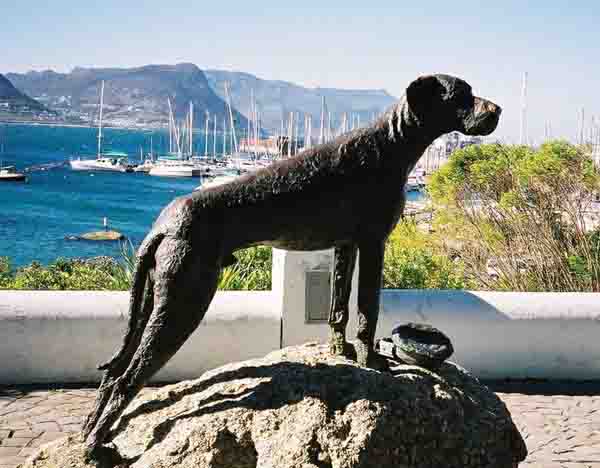
Just NuisanceFrom Wiki: Just Nuisance was the only dog ever to be officially enlisted in the Royal Navy. He was a Great Dane who from 1939-44 served at HMS Afrikander, a Royal Navy shore establishment in Simon's Town, South Africa. He died in 1944 and was buried with full military honours.
Nuisance was allowed to roam freely and, following the sailors, he began to take day trips by train as far afield as Cape Town, 22 miles (35 km) away. Despite the seamens' attempts to conceal him, the conductors would put him off the trains as soon as he was discovered. This did not cause him any problems though, as he would wait for the next train or walk to another station where he would board the next train that came along.
Although somebody offered to buy him a season ticket, the Navy instead decided to officially enlist him. It was thought he would be a morale booster for the troops serving in World War II and as a member of the armed forces he received free rail travel, so the fare-dodging would no longer be a problem.
Nuisance's service record was not exemplary. Aside from the offenses of traveling on the trains without his free pass, being absent without leave, losing his collar and refusing to leave the pub at closing time, his record shows that he was sentenced to have all bones removed for seven days for sleeping in an improper place: one of the Petty Officer's beds. He also fought with the mascots of ships that put in at Simon's Town, resulting in the deaths of at least two of them.Hehehe ... I remember visiting the statue a few years ago with my brother and his young son ... at the top of his voice, in front of a crowd of tourists, my nephew exclaimed: "Gee Dad, look at his big winkie!" ... :)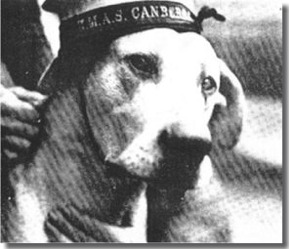 Just Nuisance was entitled to the same benefits as any other Able Seaman, which included a cap. Here he sports a cap from the HMAS Canberra in one of the many promotional photos taken during World War II..
 The town of Tsumeb in northern Namibia owes it's existence to a spectacular ore body which led to the establishment of a mine in 1905.
The De Wet Shaft headgear, shown in the image above, is situated on the main road and dominates the town's landscape. Above is the 'Bank', or shaft entrance. For twelve years this is where I descended into the depths every day.
Sadly, the ore body has been depleted and the mine has been closed since the late 1990s. The sign board at the shaft entrance showing the different communication signals used by the 'Banksman' and the 'Ontsetter' (the person in charge of the cage which transported men and materials).
Communications were by means of an electric buzzer system, (using a special key), installed on the bank and at each level where the cage stopped.
There was even an unlisted signal to express the sentiment 'F-you'. One of the 'Gangs' who worked in a specific working place or 'Stope'. At times I was required to supervise three or four gangs at the same time.
The guy with yellow hard hat in the pic above was named Daniel.
Daniel and I were alone in particularly dangerous working place where razor sharp rocks were hanging in the roof above us - we were installing wooden supports when some rocks came down, narrowly missing my back but felling Daniel who was behind me.
While he was lying stunned on the ground another rock fell and amputated the two middle fingers on his right hand.  At times the environmental working conditions were really horrific, the ground was dangerous, ventilation was poor and the heat energy-sapping. In this pic you can see miners hand-lashing high-grade ore into a scraper gully - sometimes this ore was solid metal and very heavy.
Whenever anyone complains to me how hard they work I always think back to these guys - I've never seen anyone work as hard as they did. Drilling shot-holes.
The holes would be charged with explosives and detonated at the end of the shift.
I only took my camera underground once and today I could kick myself - there are very few pictures around of the workings of this historical mine. Me with one of the crews in 1979 - it was customary to throw a Christmas party every year at my home, where the guys would arrive in their finest gear and we'd have a barbecue and a few - or more than a few - drinks.
Members of my crews were mostly Owambo-speaking and they loved to give nicknames - I had two: 'Ondudu' (Witchdoctor) and 'Gambishi' (The Cat).
Even today, so many years later, I'll be walking in some town in Namibia and hear the call "Hey Ondudu!" - and turn around to find an old familiar face smiling at me ... Later I moved into Training and one of my duties was to escort visitors on tours. Here I am in 1995 about to take some visitors underground.
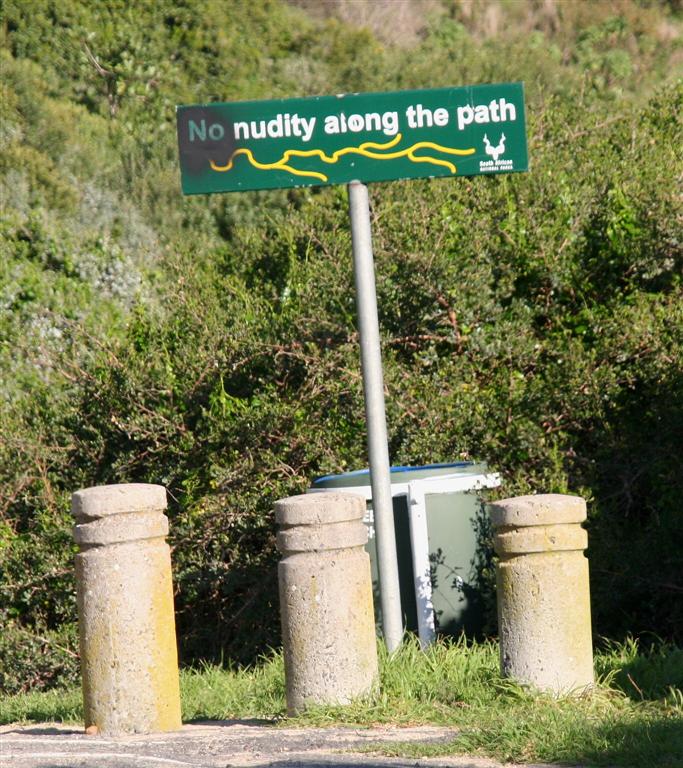
On one occasion I was preparing to take a group from one of the 'sexually-liberated' Nordic countries down into the mine.
In the group was a young lady who spoke no English and I indicated that she should wait while I found a suitable place for her to change into overalls - when I returned she had disappeared - I found her blithely changing in the miners' change house, with a group of shocked men desperately trying to conceal their nakedness ...
... I had a bit of explaining to do afterwards ...
Further reading: Tsumeb Mine - The Most Diverse Ore Body Ever Mined.