skip to main |
skip to sidebar
I awoke early in Warmbad and went out looking for images in the rising Sun: Three churches dominate the Warmbad skyline - this rock structure was built by the Rhenish Missionary Society in 1877.
The first European style buildings, including a church, were built between 1805 and 1810, by Christian and Abraham Albrecht from the London Missionary Society, thereby establishing the first mission station in South-West Africa, (pre-independence Namibia). This derelict building stands in Warmbad's 'main street'.
Through Wikipedia I found the photo below, taken between 1908 and 1914 and which appears to show the building above in better days: Donkey cart in front of the Warmbad S.A. Territories Ltd building, early 20th century.
At this time Warmbad lost its original importance as a stop-over for travellers, being bypassed by railway connections and new road construction - many of the buildings began to decay. A liquor store - or "Bottle Store" as they're known in Southern Africa - one of only two shops I saw in Warmbad, the other is a small general store.
Alcohol abuse is the root cause of many of Namibia's many social evils - it is not only a problem amongst the poor, but the wealthy as well.
The majority of Warmbad's inhabitants live in abject poverty. There is no industry in the area, residents survive from old-age pensions and subsistence goat farming.
 An old disused public Telephone Box outside the Post Office - I haven't seen one of these in ages.
 Another decaying building - there are many of these old and interesting structures in Warmbad but it seems that not much effort is being made to preserve them.
Walking around Warmbad I saw many opportunities for developing the historical aspect of the settlement in order to attract tourists and revenue to the area - there is a museum and guided tours but there's so much more that can be done.  A common type of Namibian shelter, corrugated sheets nailed to a wooden frame - the residents of this dwelling have electric power and are able to afford satellite TV.
I was forced to question my perceptions when a German woman I met there - apparently on a Mission to assist the people of Warmbad - related that she was shocked once to see four young boys kill a tiny bird then cook and devour it between themselves.
She assumed that the kids were starving.
My perception of the incident would have been that the kids, having no other form of entertainment, were doing what rural kids do, playing outside, with hunting being one of their activities ...
... and as for four of them sharing one tiny bird - that's the culture of the Poor, they share what food they have, no matter how little.
 People were starting to rise and I spotted two young women carrying their water containers to a communal water point - this is the daily reality of millions of people not only throughout Africa but, I suspect, in many other countries around the world.
I can't believe that these frail-looking girls carry those full containers home without assistance - I doubt that I could carry one container for more than a few meters.
The bliss of having water on tap ...
 The rock entrance gate of a German colonial fort which now serves as the entrance to the Police Station.
After Imperial Germany declared its territorial rights over South-West Africa, a fort was built in Warmbad in 1905 and Schutztruppe soldiers were stationed at the settlement to counter the Herero and Nama uprising. The old German Garrison Hospital, adjacent to the Doctor's house shown in the previous Warmbad post.
 My first (fuzzy) picture of an Owl - This Barn Owl lives in the old hospital and flew off as I approached.
I don't know exactly why, but I feel compelled to revisit Warmbad as soon as possible ... maybe it's the lure of the Owl and the many other birds of prey I saw there ... or perhaps I have a 'higher' purpose to serve there ...
Nah, I'm too old for going on missions ...Related Post: Southeast Namibia: Warmbad Pt 1
References:
Wikipedia
Dr Klaus Dierks
.
When I travelled to the North in October, I was accompanied by my buddy Stretch who had paid his first visit to the Southern Desert - we stopped at the Tropic Of Capricorn to take pics: After setting my camera's timer I scrambled to get into the picture but, alas, I was too slow ...
 I noticed that the reverse-sides of the Capricorn signs on either side of the road were plastered with stickers and messages left by travellers who'd stopped here.
 Visitors from all over the world had left their mark.
 I followed Dom's blog link and found an entry on his Namibia visit - I also found an image of him at the Tropic when he'd pasted his sticker on the sign.
 Is that a Japanese Bunny? - and "Ratpanat"? ... that sounds like a word from Malaysia, or Singapore?
  Disrupted by routine - Germany, Japan and Australia were here.
 Though there is a hint of humour in this sticker left by the Hong Kong Hash House Harriers, (whoever they may be), there are also deadly serious undertones to it.
For those who don't know who Julius is, he's Julius Malema, the obnoxious, recently unseated ex-leader of South Africa's ruling African National Congress (ANC) Youth League.
Malema is most notorious for inciting his followers by singing the anti-apartheid struggle song "Dubul’ iBhunu - Shoot the Boer" at his political rallies, hence the 'I'm not the Boer' reference on the sticker.The word 'Boer' means farmer and is used more generally to refer to the whole Afrikaner population and, in a wider, derogatory sense, to all white-skinned people.
Even though South Africa's High Court has ruled that the song is 'hate speech', there are still people, like enlightened guru Bono of U2 fame, who jet into South Africa and the security of a luxury hotel, then declare that it's OK - there is a time and place to sing this racist song.
The inconvenient truth is that since 1987 almost FOUR THOUSAND white people (mostly Afrikaners) have been murdered in South African farm attacks, often tortured and slaughtered in the most barbaric way.
If you have the stomach for it, you can follow the links and read the list of victims' names and gory details here.In light of the above, it would be interesting to learn on which occasions precisely, does Nobel Peace Prize nominee Bono deem it appropriate to sing a song which incites people to genocide - perhaps just before Malema's minions go out marauding?
The Washington-based organization Genocide Watch has rated South Africa as being at Stage 6 on it's 8 Stages of Genocide scale.
To me, the most frightening aspect about Malema is that, even though he's been temporarily disabled, he may well become a future President of South Africa.
Cartoon by Zapiro ... and on a lighter note, we did finally get it right - well, sort of ....
Towards the end of November I took a trip to south-eastern Namibia.
It was my first visit to the area - I had heard that it was underdeveloped but was not prepared for the poverty I found there. Our first stop was Warmbad, a depressed settlement on the Homs River.
Warmbad was known to the Nama people for centuries as |Aixa-aibes and was first named in 1760 by scout Jacobus Coetzee, the first documented European to cross the Oranje River into the South-West African territory that today forms the state of Namibia.
'Warmbad' means 'hot bath' in Afrikaans and German and refers to the hot spring around which the settlement is located. One of the first intact buildings I saw was this shebeen - Para-dise, which started the Dylan song, 'The Ballad of Frankie Lee and Judas Priest' playing in my head:
“Eternity ?” said Frankie Lee
With a voice as cold as ice
“That’s right”, said Judas Priest, “Eternity
Though you might call it Paradise” The community-owned camp-site is sub-standard and unattractive so we chose to rather stay in the bungalows which were decent and not too expensive.
Pictured above are two of the single bungalows.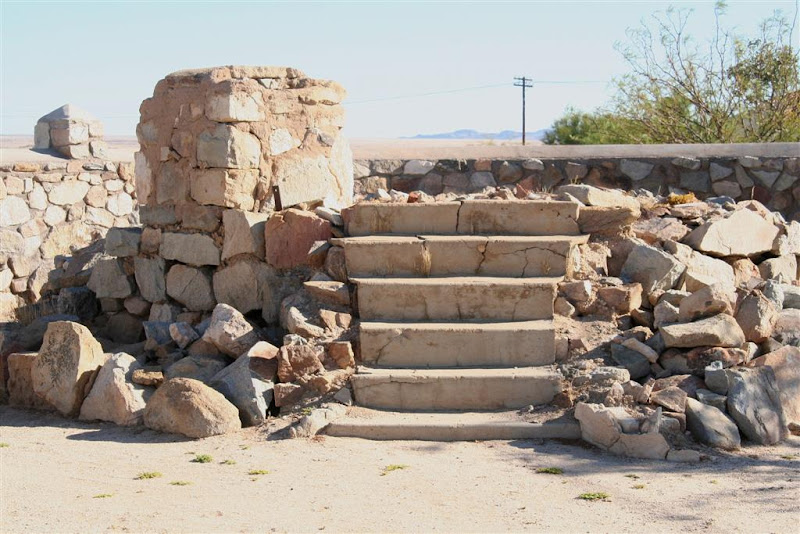 Stairway to Paradise?
Some of the oldest buildings and ruins in Namibia are to be found in Warmbad - built by Missionaries in the early 1800's. At the Hot Spring close to the Camp Site a bath has been built, housed in a fancy building but, the place is closed.
Some kids had gained entrance through an open window and were frolicking in the water.
It's my understanding that various Governments and aid organisations have donated millions to the Warmbad community so that they can improve facilities and attract tourists to this historically important area but, for reasons unknown to me, they just don't seem to be able to get their act together. Around sunset, I took a walk around the area to see what I could capture in the magic light.
A goat kid jumps off a wall. There are many goats here - they seem to be the only animals that thrive and are an important source of food and revenue for the community. I was pleasantly surprised to find the largest concentration of Aloe garipensis I've seen, in the rocks adjoining the camp-site - there are hundreds and they were glowing bright red in the setting sun.
 Ruins - the camp-site and bungalows are to the left of the palm trees - in the distance, the desolate, flat landscape.
 I was fascinated by this old rock building - not only because it had no windows and only one locked entrance, but also for the way the builders had constructed the roof with rocks too ... I wonder what purpose the building served?
 The Doctor's house adjoining the old hospital - a relic of the German Colonial era - I took many pics here.
 After the sun had set this bird of prey, which had been roosting in the old hospital, hovered over me indignantly at being disturbed. I've identified it - probably incorrectly - as a Rock Kestrel.
Unfortunately, being hung-up on taking pics of the ruins I'd forgotten to change my ASA settings and the image turned out fuzzy.
References:
Wikipedia
Dr. Klaus Dierks.
 When I came from the North a few weeks ago I camped-over at Solitaire, an outpost on the edge of the Namib Desert.
The next morning I was up before Sunrise and took a route through the Nauklauft Mountains. I was heading for Büllsport, a Guest Farm on the eastern edge of the mountains - the 55km journey took ages because I kept stopping to take photos in the cloudy morning light.
 I ordered a much-needed coffee and then walked around to view the reason I was here:
 The Rocks.
 These long flat rocks occur somewhere on the farm and the owners have used them to construct very attractive walls, or fences. I'd seen them before but I wanted to take another look.
 Some of the rocks are over 2 meters tall and I would love to get my hands on a few - to build a Stonehenge type rock circle on my lawn - but, I'd been told on a previous visit, a few years ago, that there were none available for sale.
 While drinking my second cup of coffee I was chatting with the owner and hopefully asked her if she had more of the rocks and, any for sale - to my delight she said yes, she had a small stockpile of them right there.
... I grabbed my tape-measure and bought two on the spot.
From now on I'll be taking that route every time I head north. One of the guest rooms at Büllsport.
 After I'd left Büllsport I saw quite a few of these rocks standing on farms I passed so I guess they must be abundant in the area.
I'll tell you what, if I had a few thousand Bucks in small change, I'd hire a truck, cart a few loads of the Rock to my home in the north and start building another Dwelling with them ... after completing the Stone-Circle of course ....
A few weeks ago I was driving somewhere on a 165km stretch of road in the Desert.
The journey had been long, it was hot and I was in semi-automatic mode ... Suddenly I passed a long-distance cyclist travelling in the opposite direction.
Alert now because I'd missed a photo-op, I spotted another cyclist approaching in the distance and so I slowed down, pulled off the road and grabbed my camera.
 Lo and behold, it was a lady cyclist, kitted-out for a long-distance journey.
 With a wave she stopped and pulled over - she told me that her name is Brenna and I heard well enough to get it right first time.
Brenna is Canadian and, together with her partner, who I had passed earlier, was cycling from Cape Town to Morocco ... I was amazed at the scale of their adventure. She paused briefly to give me her e-mail address so I could post the pics to her.
 With a last smile it was time for her to press on.
 ... and then she was gone, continuing her journey of a Lifetime.
I admire people who embark on this kind of adventure, travelling a continent on their own power, uncomplicated, with miles and miles to unclutter the mind - vulnerable and exposed to nature completely.
I think that Namibia is probably one of the best countries to cycle through.
Happy Trails Brenna.
Related Posts:
The Zen Of long-distance Cycling
Intrepid Travellersps ... I posted this earlier but had to delete because the pics were not loading from my Picasa album ... I'm trying Photobucket, please let me know if there are any hassles with the images ....


