skip to main |
skip to sidebar

 From the Source: Albertus Seba (1665-1736) was a Dutch apothecary and collector, who, in the 1730s began a project to publish a fully-illustrated catalogue of his renowned collection of naturalia. Seba oversaw the production of the first two volumes of this opus, Locupletissimi Rerum Naturalium Thesauri Accurata Descriptio..., issued in 1734 and 1735. Two further volumes were issued posthumously, in 1758 and 1765.More images at the source.
Good rains are falling in Namibia and atmospheric conditions are right for the appearance of a much sought-after delicacy - mushrooms, or 'Omahova' as they're known here.
Two years ago, I came upon these two dudes on a highway in the middle of nowhere. They were selling these giant mushrooms which they'd collected in the bush: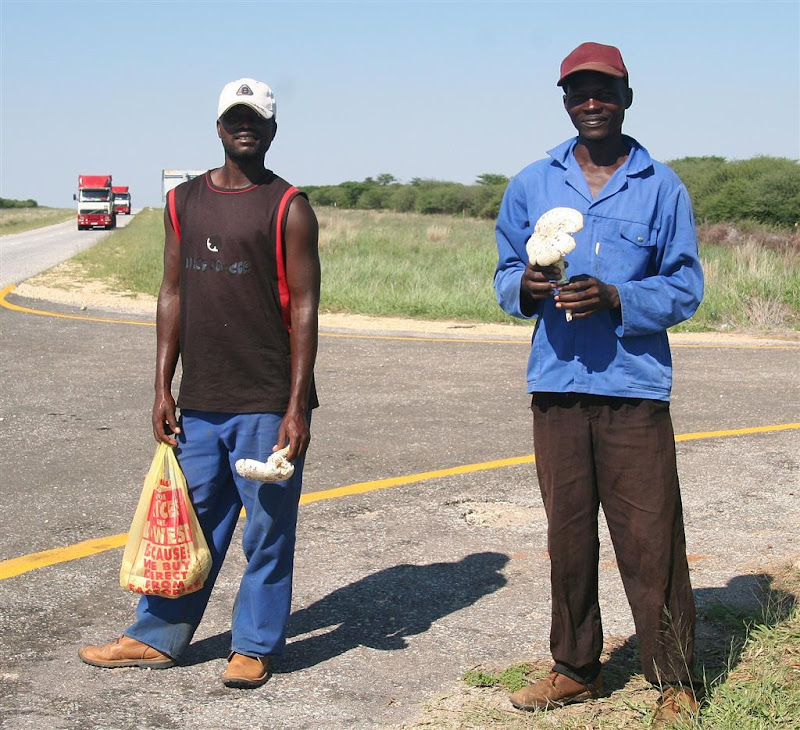
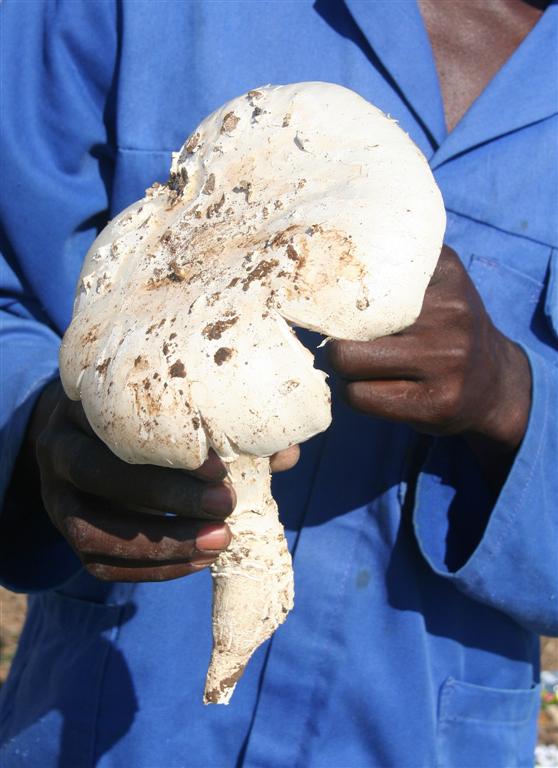 The mushrooms grow only on termite mounds and appear a few days after good rain showers and cloudy, misty weather. I've been told, but unable to substantiate as fact, that the spores are distributed through the dung of cattle, whereafter they're transported into the mounds and nurtured by the termites.
It is also said that they only grow on the northern side of the mounds, i.e. away from direct sunlight.
When buying Omahova it is best to get them before they open-up like the ones in the pics. When they're open they go soggy very quickly and are prone to worm infestations.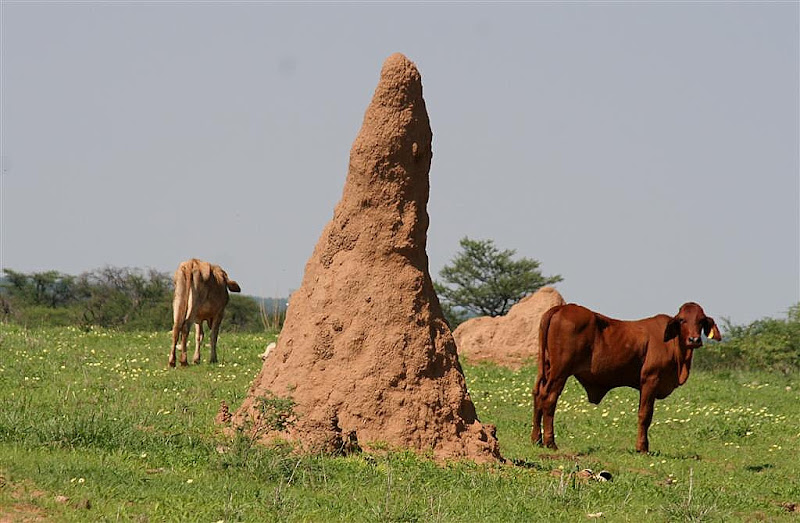 The last pic is to illustrate how big the termite mounds can be, though some of them get a lot bigger.
I'm not usually very fond of mushrooms, but I'd kill for these. When prepared by someone who knows how to, they're divine. One method is to cut the stems as steaks and poach in buttered, fried onions, ... mmmm.
 2010 has started badly; early on new year's day I was told that the lady who looks after my house when I'm not here, had died.
Meme Anna was one of the few people I trust to take care of Stoffel and other animals properly.
She was someone I depended on heavily when I'm away in the desert.
Her death means that I have to stay here in the north of Nam until I can re-organize my life.
It also means that I'm marooned in spayce ... I've explained before why I can't afford to be online much but, instead of going cold turkey, I'll try to answer comments and post the occasional draft that I have saved ... a kind of hit-and-run operation ... (believe me, it can take 4 to 5 minutes to load a page - if it doesn't just time-out) ...
Anyway, while I'm here I'll be building and thinking.
You guys must keep in touch hey ....
 Photographer Pieter Hugo writes: "A few weeks later I was on a plane to Lagos. Abiola met me at the airport and together we took a bus to Benin City where the ‘hyena men’ had agreed to meet us. However, when we got there they had already departed for Abuja. In Abuja we found them living on the periphery of the city in a shantytown - a group of men, a little girl, three hyenas, four monkeys and a few rock pythons. It turned out that they were a group of itinerant minstrels, performers who used the animals to entertain crowds and sell traditional medicines. The animal handlers were all related to each other and were practicing a tradition passed down from generation to generation"

Photo Credits: Pieter HugoAccording to the Hyaena Specialist Group in their article The Truth About Hyaenas: debunking hyaena myths:
"Although a few people in Africa and Asia find very young hyaenas in nature and raise them as pets, these animals generally appear to be extremely unhappy as “domestic companions” as adults, and must often be kept muzzled at all times so that they do not harm people or property.
A muzzle prevents the hyaena from being able to groom itself properly. As spotted hyaenas need several years of practice to become proficient hunters, and as they are deprived of this practice when reared as pets, it is effectively a death sentence for a captive-reared hyaena to be released into the wild.
In addition, pet hyaenas cannot be released for fear that they might transfer new pathogens from captive environments into the wild. Upon reaching adulthood, many "pet" hyaenas must therefore be euthanized."
.

Image Credit: UnknownFrom Big Cats Online:'The Caracal in appearance resembles the Lynx in having characteristic dark tufts on its large, pointed ears and is indeed often referred to as the African Lynx or Desert Lynx, however the caracal is not closely related to the true lynx species.
Extending the visual comparison, the body of the caracal is slimmer and less stocky, its legs are thinner and its tail longer than the Lynx. It can grow up to 3 feet in body length and sport a tail about a third of its body size.
The name Caracal is derived from the Turkish word "karakulakâ", meaning "black ear".
In hunting, the caracal is mainly nocturnal, but will also use the twilight hours to search out its prey. The caracal is also well known for using its agility and superior jumping ability to catch birds just after take-off.'
Image Credit: UnknownThese beautiful cats are rarely seen in the wild, I've never encountered one. My daughter is proud of the fact that she's seen them five times whilst she was working as a tour guide in the Etosha Pans in northern Namibia. I must admit, I'm pretty impressed with her ability to spot well camouflaged animals in the bush, even when she's driving ...
Here's a link to a post I did on some photo's she took of Caracal Orphans
NadineCrowPic.


 OneStonedCrow Pics


