skip to main |
skip to sidebar

Image Credit: UnknownFrom Wiki: The Aardvark (Orycteropus afer) is a medium-sized, burrowing, nocturnal mammal native to Africa.
The name comes from the Afrikaans/Dutch for "earth pig" (aarde earth, varken pig), because early settlers from Europe thought it resembled a domesticated pig. However, the aardvark is not closely related to the pig ... The closest living relatives of the aardvark are the elephant shrews, along with the sirenians, hyraxes, tenrecs and elephants.
The aardvark is nocturnal and is a solitary creature that feeds almost exclusively on ants and termites; the only fruit eaten by aardvarks is the aardvark cucumber.
An aardvark emerges from its burrow in the late afternoon or shortly after sunset, and forages over a considerable home range encompassing 10 to 30 kilometers, swinging its long nose from side to side to pick up the scent of food.
When a concentration of ants or termites is detected, the aardvark digs into it with its powerful front legs, keeping its long ears upright to listen for predators, and takes up an astonishing number of insects with its long, sticky tongue - as many as 50,000 in one night have been recorded.
Image Credit: Detroit ZooThis image of a new-born Aardvark, named 'Amani' (Swahili for "peace"), reminded that I've never seen one of these shy, elusive creatures in the wild.
I've seen hundreds of holes they've dug in their search for termites though; I took this pic of a freshly-dug hole in November - you can see the creature's footprints and tail-drag marks in the sand:.JPG) OneStonedCrow PicA local name for the Aardvark is "Anamanama" (Ah-nah-mah-nah-mah) and here's the kind of image I'd like to capture someday:
OneStonedCrow PicA local name for the Aardvark is "Anamanama" (Ah-nah-mah-nah-mah) and here's the kind of image I'd like to capture someday: Image Credit: Beverly Joubert.
.JPG) Up until about three years ago I would often stop and pick up hitchhikers - I had hiked long distances in my youth and felt a certain obligation towards fellow travelers.
Up until about three years ago I would often stop and pick up hitchhikers - I had hiked long distances in my youth and felt a certain obligation towards fellow travelers.
After hearing reports of attacks on motorists, I started thinking about the dangers and, thereafter, would only stop for women or older folk.
However, when I gave a lift to two women who became obnoxious and aggressive, my attitude hardened even further.
The final straw though, was when I gave a lift to a woman on a long stretch of road. Despite the fact that I had pulled over for a pee break during the journey, instead of asking me to stop when she felt the need, she simply relieved herself on the front seat through her dress - I only discovered what she'd done after I'd dropped her off and, leaning over to get something out of the cubby, I felt the wetness on my hand ... there was an unpleasant smell in the car for weeks afterwards.
From that day on I decided, enough! - no lifts to anyone, no matter how innocent, pretty or desperate-looking - no exceptions.
Even though I know that someone will eventually stop for them, I often feel bad when passing hikers, as in this case, a woman and young child standing in the rain.
What worries me when I pass vulnerable-looking people like this is that, by traveling with me they would be safe, they will arrive at their destination unharmed. What if they're picked-up by a reckless driver or someone with bad intentions?
On the other hand, it is their choice to be on the road, should I take responsibility for their lives?.JPG) Would Mandela, or even Obama, have asked their drivers to stop as they cruised by in their limos?
Would Mandela, or even Obama, have asked their drivers to stop as they cruised by in their limos?
What would you have done, would you have stopped for this Madonna and Child?
'Oh, think twice, it's just another day for
For you and me in paradise
Oh, think twice, it's just another day
For you, you and me in paradise
Just think about it'
Phil Collins
.

BUNGEE JUMPINGFrom Wiki: 'Bungee jumping (also spelt "Bungy") is an activity that involves jumping from a tall structure while connected to a large elastic cord. The thrill comes as much from the free-falling as from the rebounds.
When the person jumps, the cord stretches and the jumper flies upwards again as the cord snaps back and continues to oscillate up and down until all the gravitational potential energy and kinetic energy of the fall is converted into heat, sound, and other forms of non-mechanical energy.'
Call me chicken, I don't care ... this is not for me ... I prefer to just roll a joint and get a natural high. I mean, look at some of the dangers:'There is a wide spectrum of possible injuries during a jump. One can be injured during a jump if the safety harness fails, the cord elasticity is miscalculated, or the cord is not properly connected to the jump platform.
Other injuries include eye trauma, rope burn, uterine prolapse, dislocations, bruises, whiplash, pinched fingers and back injury.'
Well, I don't have to worry about uterine prolapse but, imagine if your eyeballs pop out and do a bungee of their own; ... or worse, a lifetime of embarrassment if you mess your pants and it's posted all over the internet like the guy in the pic below:

... no thanks ...
Image Credits: Unknown.

 From the Source: Albertus Seba (1665-1736) was a Dutch apothecary and collector, who, in the 1730s began a project to publish a fully-illustrated catalogue of his renowned collection of naturalia. Seba oversaw the production of the first two volumes of this opus, Locupletissimi Rerum Naturalium Thesauri Accurata Descriptio..., issued in 1734 and 1735. Two further volumes were issued posthumously, in 1758 and 1765.More images at the source.
Good rains are falling in Namibia and atmospheric conditions are right for the appearance of a much sought-after delicacy - mushrooms, or 'Omahova' as they're known here.
Two years ago, I came upon these two dudes on a highway in the middle of nowhere. They were selling these giant mushrooms which they'd collected in the bush: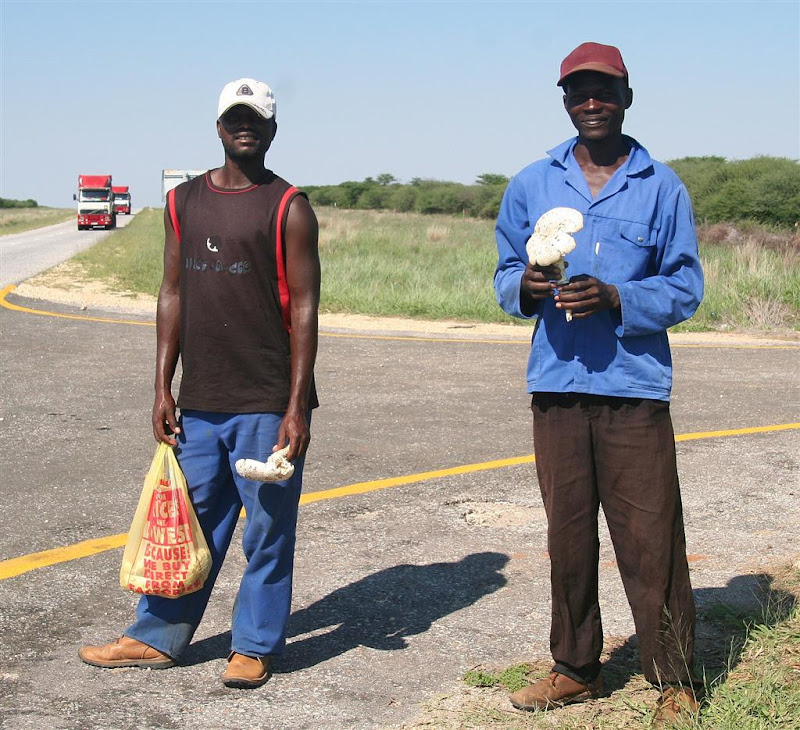
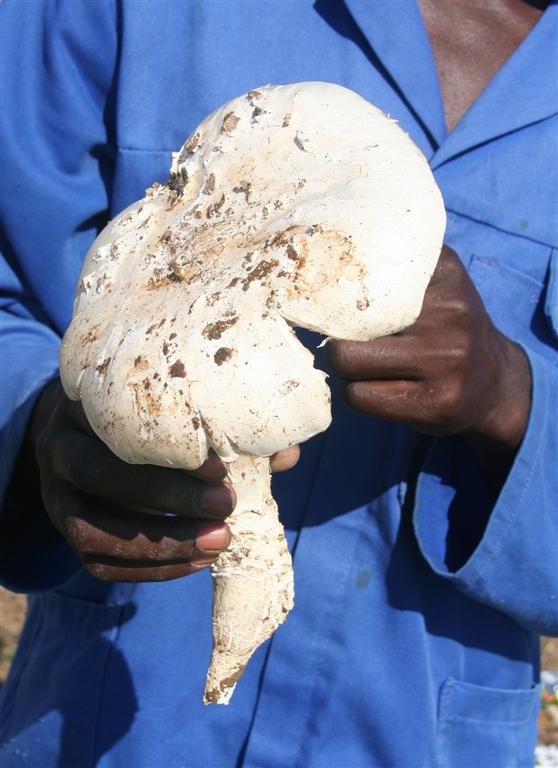 The mushrooms grow only on termite mounds and appear a few days after good rain showers and cloudy, misty weather. I've been told, but unable to substantiate as fact, that the spores are distributed through the dung of cattle, whereafter they're transported into the mounds and nurtured by the termites.
It is also said that they only grow on the northern side of the mounds, i.e. away from direct sunlight.
When buying Omahova it is best to get them before they open-up like the ones in the pics. When they're open they go soggy very quickly and are prone to worm infestations.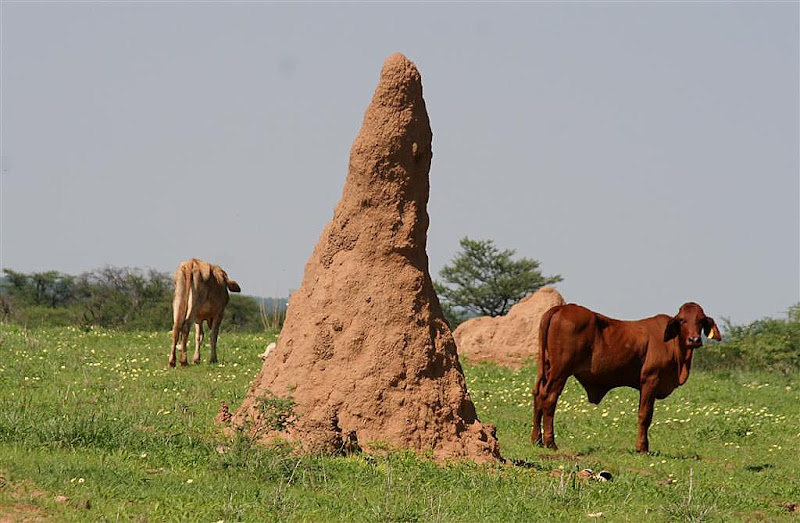 The last pic is to illustrate how big the termite mounds can be, though some of them get a lot bigger.
I'm not usually very fond of mushrooms, but I'd kill for these. When prepared by someone who knows how to, they're divine. One method is to cut the stems as steaks and poach in buttered, fried onions, ... mmmm.
 2010 has started badly; early on new year's day I was told that the lady who looks after my house when I'm not here, had died.
Meme Anna was one of the few people I trust to take care of Stoffel and other animals properly.
She was someone I depended on heavily when I'm away in the desert.
Her death means that I have to stay here in the north of Nam until I can re-organize my life.
It also means that I'm marooned in spayce ... I've explained before why I can't afford to be online much but, instead of going cold turkey, I'll try to answer comments and post the occasional draft that I have saved ... a kind of hit-and-run operation ... (believe me, it can take 4 to 5 minutes to load a page - if it doesn't just time-out) ...
Anyway, while I'm here I'll be building and thinking.
You guys must keep in touch hey ....


.JPG)
.JPG)
.JPG)
.JPG)
.JPG)
.JPG)

.JPG)
.JPG)
.JPG)
.JPG)
.JPG)
.JPG)


